Compare cheap 7 seater car hire at Alicante Airport. Plus AP-7 tolls south, Benidorm’s low emission zone, the V-16 rule and Spanish child seat law.
Before you book, decide which way you are heading out of the airport. North or south changes the tolls you pay and the town centre rules you face.
British travellers are Alicante-Elche Airport’s biggest market by a distance. In July 2026 alone, around 734,000 UK passengers passed through, out of more than 2.3 million in total, according to Aena figures reported by Murcia Today.
Many of them are families heading for a villa on the Costa Blanca, often with grandparents along. That is 7 seater territory.
This guide covers what changes once you leave the terminal: the toll road south, Benidorm’s low emission zone to the north, the safety kit Spanish hire cars now carry and the child seat rules that matter in a third row.
North or south: the first turn decides your costs
The airport sits about 8 km from Alicante city centre, with the A-7 motorway and the N-332 coast road on its doorstep (Spain’s official tourism site). From there, most UK families split two ways.
Heading south to Torrevieja or Orihuela Costa
The AP-7 between Alicante and Cartagena still charges tolls, and its operator holds the concession until 2048 (elDiario.es).
The stretch that catches villa holidays is the 15 km between Los Montesinos and La Zenia. In high season it costs about £4.34 (€5.08) each way (El Debate).
That sounds small until you count the trips. A daily return to the beach or the supermarket for a week is 14 crossings, roughly £61 (€71). The free alternative is the N-332, which runs alongside the AP-7 and is known for heavy congestion.
Heading north to Benidorm or Altea
The AP-7 north of Alicante towards Tarragona has been toll-free since 1 January 2020 (elDiario.es). The AP-7 bypass around Alicante itself became permanently free in December 2025 (Murcia Today).
The catch is in Benidorm. Its low emission zone (ZBE) covers about 74 hectares split into central sub-zones and runs 24 hours a day, enforced by cameras that read number plates (RACE).
Cars with the cleaner DGT environmental labels, C and above, enter freely. Cars with a B label or no label need authorisation first, according to Benidorm council’s own guide.
Fines are £171 (€200), cut to £85 (€100) for prompt payment (Alicante Plaza). Recent hire cars normally carry a C or ECO label. If your hotel sits inside the zone, or you are offered an older car, ask at the desk which label it has.
Alicante 7 Seaters for the Costa Blanca
One search shows the 7 seaters at Alicante, in the terminal and off the airport, with the total price for each.
A fortnight’s villa luggage needs a bigger boot than you think
Two weeks in a villa means big cases, and big cases are where 7 seaters fall short. A large suitcase holds 80 to 110 litres. With all seven seats in use, even the roomiest common 7 seaters offer about 340 to 350 litres of boot.
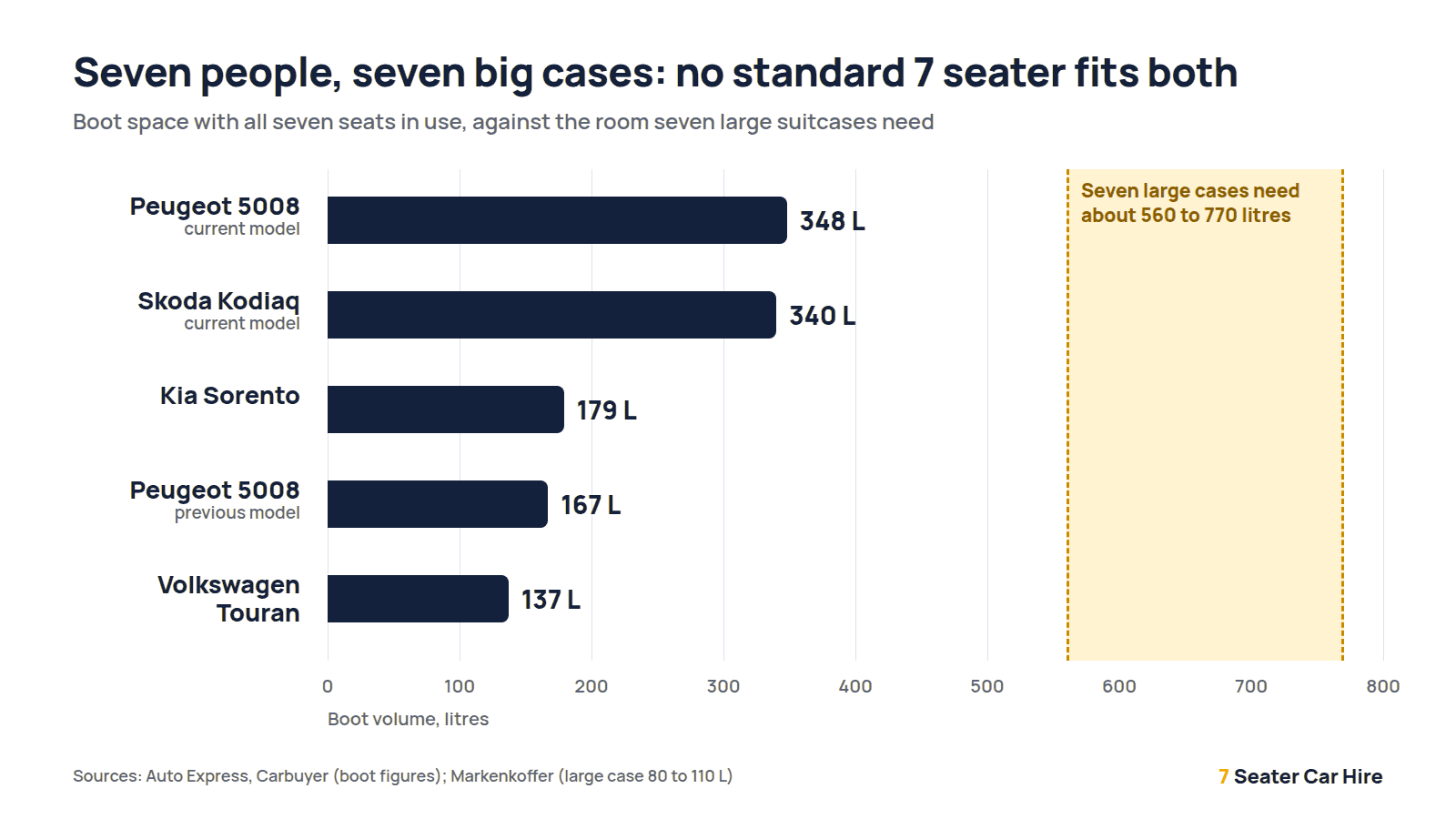
In practice, seven people with a large case each will not fit a standard 7 seater. Rental classes use ACRISS codes: SV means seven or more seats, while FV means seven or more seats plus more space.
For a full family with full luggage, the FV class or an 8 or 9 seater is the realistic choice. For five people, a 7 seater with the third row folded is ideal: the current Peugeot 5008 grows to 916 litres that way.
Cases on show: the risk nobody mentions
The UK Foreign Office warns that criminals in Spain target hire cars, and that the moment of collecting a car at the airport is a vulnerable one (GOV.UK travel advice). It also warns of drivers being flagged down with claims that something is wrong with their car.
A 7 seater carrying seven people adds a twist. With passengers in the third row, the boot cover usually cannot be used. Volvo’s own manual for the XC90 warns never to fit it when the third row is occupied (Volvo).
That leaves every case visible through the rear window. Drive straight to the villa and unload before the first supermarket run, rather than stopping on the way with the luggage on display.
The kit a Spanish hire car must carry
Hire cars collected at Alicante are almost always Spanish-registered, and that matters. Since 1 January 2026, the connected V-16 warning light is the only legal way to signal a broken-down Spanish vehicle, replacing warning triangles (Spanish Ministry of the Interior).
The light goes on the roof and sends the car’s location to the DGT, which warns other drivers through navigation apps and roadside signs. Not carrying one is a minor offence with a fine of about £68 (€80).
Anyone leaving the car on an interurban road or hard shoulder must also wear an approved high-visibility vest, under article 118 of Spain’s traffic regulations (Motor16).
Check the car for both before you drive off. The Ministry’s advice is to leave the car only where it is safe; otherwise stay inside with seatbelts fastened, which in a full 7 seater means keeping everyone in their seats.
Child seats in Spain, and why the third row helps
In Spain, children 135 cm tall or under must use an approved child restraint suited to their height and weight. Getting it wrong costs £171 (€200) and four points (DGT). The DGT recommends keeping a restraint until 150 cm.
Those children must also travel in the back seats. The front seat is allowed only in narrow exceptions, such as when every rear seat is already taken by other children (Fundación MAPFRE).
A 7 seater’s third row counts as back seats, which gives families room to plan. Seats that use ISOFIX usually belong in the middle row, since many 7 seaters only have ISOFIX there. High-back boosters, which use the car’s own belt, can often go in the third row instead. Check the third row has proper three-point belts before you rely on it.
Collecting the car at Alicante-Elche
The airport’s on-site hire firms all have desks on the ground floor arrivals level, Planta 0 (Aena). Firms that are not on Aena’s list operate from depots outside the airport, usually reached by shuttle bus.
An off-airport depot can mean a lower price. It also means loading seven people and their cases onto a shuttle, then waiting at the depot. Weigh that against the saving shown in the search results, especially with tired children.
Allow extra time at the border too. Since the EU’s Entry/Exit System began, UK passport holders register fingerprints and a photo on arrival in the Schengen area (GOV.UK). Add your flight number to the booking so the desk knows if you are delayed.
Paperwork for UK drivers in Spain
A UK photocard licence is valid for driving in Spain, and you must carry it with your passport or other ID at all times (GOV.UK). Provisional licences are not accepted, and old paper licences need upgrading first.
Spanish police issue on-the-spot fines. If you accept the fine and pay within 20 days, it is cut by 50%. The hire desk may also ask for a DVLA check code, which you can generate on GOV.UK up to 21 days before you travel.
Staying on the Mar Menor or at La Manga? Our Murcia Airport guide covers the airport closer to those resorts.
Spending less on a 7 Seater at Alicante
- Compare the total, not the daily rate. Fuel policy, deposit, insurance excess and extra driver charges all sit outside the headline price. A full-to-full policy means you pay only for the fuel you use.
- Budget for your route. Staying near La Zenia or Orihuela Costa and driving north daily adds AP-7 tolls in high season. Staying north of Alicante adds none.
- Price child seats per day. Hire firms usually charge per seat, and a family needing two or three can add a noticeable sum over a fortnight. Bringing your own is often cheaper.
- Book early with free cancellation. Summer demand for 7 seaters on the Costa Blanca is high. Locking in a cancellable rate and searching again nearer the date lets you rebook if prices fall.
Check Alicante 7 Seater prices for your holiday
Put in your flight times to compare cheap rates before Easter and summer demand lands.
Questions people ask
Do I pay tolls driving from Alicante Airport to Benidorm?
No. The AP-7 north of Alicante has been free since January 2020, and the Alicante bypass is now permanently free too. Tolls still apply on the AP-7 south towards Cartagena.
Can my children sit in the third row of a 7 Seater in Spain?
Yes. Spanish law requires children 135 cm or under to travel in the back seats in a suitable restraint, and the third row counts as back seats. Check the third row has three-point belts or ISOFIX for the seat you plan to use.
Does my hire car need a V-16 warning light?
A Spanish-registered car does, since 1 January 2026, and almost every hire car at Alicante is Spanish-registered. Check it is in the car before leaving the airport, along with a high-visibility vest.
Will my hire car be allowed into Benidorm’s low emission zone?
If it carries a C label or a cleaner one, yes, with no registration needed. Cars with a B label or none need authorisation first. Recent hire cars normally qualify, but ask at the desk if your accommodation is in the centre.
Where can I compare cheap 7 Seater deals at Alicante Airport?
No single firm always has the lowest price. Prices move with dates and demand, so compare several firms for your exact dates, then check the fuel policy, deposit and depot location before choosing.
